
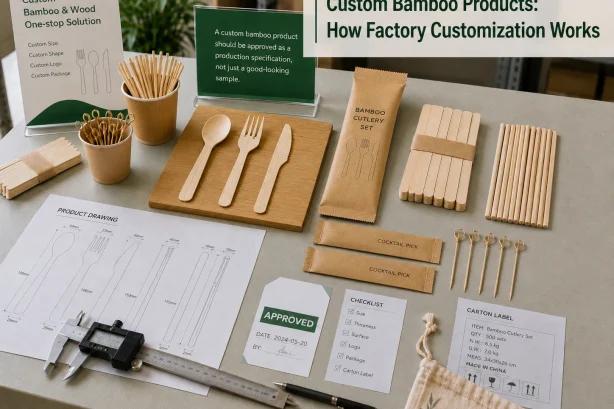
Quick answer: OEM bamboo products work best when the buyer gives the factory a production-ready specification, not only a photo or a rough idea. BambooSaint can review bamboo and birchwood disposable product material choices, size and shape requirements, logo methods, retail packaging, automated packing needs, samples, and quality checks before bulk production. The safest path is simple: define the application, confirm the drawing and sample, lock the packaging, check the first production pieces, and keep environmental claims tied to real documents.
An OEM custom disposable product usually starts with a simple request: a different length, a branded sleeve, a special set combination, a private-label carton, or a product shape that fits one menu better than a standard catalog item. That sounds straightforward until the factory has to turn the request into repeatable production.
For B2B buyers, OEM bamboo products and wooden disposable items should not be treated as one-off artwork projects. They are production projects. A good sample matters, but the real question is whether the same material, size, finish, packing, and claim can hold up when the order moves from a few pieces to cartons, pallets, and containers.
This guide focuses on the practical side of OEM customization: what information to give the supplier, how to review samples, where logo and packaging decisions can create risk, and what BambooSaint can support based on its public customization and FAQ pages. It does not repeat the separate discussion about MOQs, deposits, or payment security.
OEM Bamboo Products Start With the Product Job
“Custom bamboo fork” is not enough information for a factory. The same fork may need to work in a salad bowl, a takeaway noodle box, an airline tray, a hotel amenity pack, or a retail shelf set. Each use changes the specification.
Before asking for a quote, define the job the product has to do. Is the item meant for hot food, chilled desserts, vending, airline service, catering, retail, or industrial food packing? Does it need individual wrapping? Will a machine count, feed, or seal it? Does the buyer need logo branding on the utensil itself, or only on the sleeve and carton?
BambooSaint’s customization page lists bamboo and wooden disposable product material options, size and shape engineering, automated bulk packing, safe logo design support, and logistics-optimized packaging. Those are useful only when the buyer gives enough detail for the factory to turn the idea into a measurable production standard.
Information a Factory Needs Before Custom Sampling
| Decision | What to Confirm | Why It Matters in Production |
|---|---|---|
| Material | Bamboo, birchwood, target grade, FSC need, food-contact market | Material affects strength, color tone, finish, documents, and claims. |
| Size and shape | Length, width, thickness, curve, edge, tolerance, drawing | Small changes can affect tooling, machine fit, carton volume, and user comfort. |
| Branding | Logo file, position, size, hot stamping feasibility, artwork approval | Branding must stay readable without creating food-contact or surface problems. |
| Packaging | Inner bag, sleeve, retail box, carton label, barcode, shipping mark | Packaging controls presentation, hygiene, handling, and container loading. |
Turn OEM Bamboo Products Into Factory Specifications
A buyer may send a sample photo and say, “Can you make this?” A factory can start from that, but it should not end there. The better question is: what exact version should be made repeatedly?
For OEM bamboo and wooden disposable products, the specification should cover the visible product and the invisible controls. The visible parts are size, shape, logo, packing, and carton design. The invisible parts are tolerance, material grade, surface finish, moisture control, inspection method, and which documents support the finished product.
BambooSaint says its R&D and production teams can review product drawings, logo files, size requirements, application needs, packaging requirements, and mass production feasibility before an OEM project begins. That review is where buyers should push for clarity. If a detail will matter later, it belongs in the specification before sampling.
Specification note: Do not approve an OEM custom disposable product only by appearance. Put dimensions, tolerances, material, finish, logo position, packaging format, carton marks, and approved sample references into the order file.
Logo and Packaging Decisions Should Be Production Decisions
Logo and packaging choices often look like marketing work, but in a factory they affect production. A logo may change the surface process. A sleeve may change machine feeding. A retail box may change carton quantity. A barcode label may change warehouse handling. A claim printed on the pack may require documents that match the exact product and material.
BambooSaint’s FAQ says hot stamping can apply a logo directly to selected bamboo or wooden disposable products where suitable. Its custom packaging support can include paper wrapping, retail boxes, SKU labels, barcode labels, shipping marks, and private-label packaging review. Those options should be tested together, not separately.
For example, a buyer may approve a clean hot-stamped logo on a sample stick, then later discover that the logo is too small on a different width, or that the sleeve artwork makes the carton inefficient. The fix is not to argue after production. The fix is to approve the logo, sleeve, label, carton, and final sample as one OEM disposable product system.
Test OEM Bamboo Products With Real Samples
Samples are useful only if the buyer tests them like the real product. A custom coffee stirrer should be tested in the cup size and temperature it will face. A bamboo skewer should be tested with the food weight and grill conditions it will meet. A wrapped cutlery set should be opened by the same kind of customer who will use it.
BambooSaint’s sample FAQ says buyers can use samples to check surface finish, material feel, structure, packaging, LFGB compliance, smoothness, splinter control, size, density, and food-contact suitability. For customized OEM samples, the page notes that special sizes, packaging mockups, and hot-stamped logos may need artwork confirmation and extra preparation.
The important point is not whether a sample looks good on a desk. It is whether the product survives the buyer’s real handling, service, storage, and presentation requirements. If the product will go through a filling line, packing line, retail shelf, delivery bag, or airline tray, the sample should be judged against that setting.
Control the Gap Between Sample and Mass Production
OEM custom orders can fail when the approved sample is treated like a display piece instead of a production reference. Bamboo and wood are natural materials, so grain and tone will vary. That is normal. But size, shape, finish, packing, hygiene, and the agreed specification should be controlled.
BambooSaint’s FAQ says approved samples can be pulled from active production lines where possible, instead of being hand-picked from a separate display batch. It also mentions line sampling, automation, optical sorting, specification control, and pre-shipment review. That matters because buyers need the bulk order to match the approved commercial standard, not a perfect show sample that production cannot repeat.
First Article Inspection is another practical control point. BambooSaint says it checks first approved pieces against confirmed size, shape, finish, and packing requirements before mass production continues. For OEM disposable products, this is the moment to catch size drift, surface defects, logo placement problems, or carton mistakes while the order can still be corrected.
Keep Environmental Claims Specific and Documented
Custom packaging often includes words like natural, sustainable, compostable, biodegradable, plastic-free, or FSC. These words need care. The FTC Green Guides warn against broad, unqualified environmental benefit claims such as “green” or “eco-friendly” because broad claims are hard to substantiate. FSC chain of custody also depends on traceability through processing and distribution.
For B2B buyers, the practical rule is simple: claim only what the product and package can support. If the utensil is bamboo but the wrapper has a coating, adhesive, window, or mixed material, the pack claim should reflect that. If the buyer wants an FSC claim, the certificate scope, claim wording, material flow, and trademark use should be checked before artwork approval.
This is where OEM disposable product development and compliance meet. A beautiful sleeve can still create risk if the printed claim is broader than the documents behind it. Review the material list, market requirement, certification records, food-contact reports, and final artwork together.
A Practical Custom Product Workflow
- Define the use case. Confirm food type, service format, handling method, destination market, and whether the item needs wrapping or retail display.
- Write the specification. Lock material, dimensions, tolerances, finish, logo position, packing format, carton marks, and document requirements.
- Review feasibility. Ask the factory to check tooling, material, machine schedule, artwork, packing method, and production limits before sampling.
- Approve the sample as a system. Check the product, logo, sleeve, label, carton, and claim wording together.
- Use First Article Inspection. Compare the first production pieces against the confirmed specification before the run continues.
- Request shipment evidence. For important custom orders, ask for photos, videos, inspection records, or retained samples before dispatch.
What to Send BambooSaint Before Asking For a Custom Quote
A clear inquiry shortens the back-and-forth. Send the product type, target size, drawing or reference photo, material preference, logo file, packaging concept, destination market, expected annual volume, launch timeline, and compliance needs. If you already have a retail box or sleeve layout, include the artwork file and barcode requirements.
If the project is still early, start with the product job instead of forcing a finished design too soon. BambooSaint can review OEM/ODM customization support, sample options, and production feasibility. Buyers can also request product samples before confirming a bulk order.
FAQs
What Information Does a Factory Need For OEM Bamboo Products?
The factory needs the product type, use case, material, target size, drawing or reference sample, logo file, packaging format, carton details, destination market, order volume, and compliance requirements. The more measurable the brief is, the easier it is to control sampling and bulk production.
Can BambooSaint Make Custom Logos on Bamboo or Wood Products?
BambooSaint states that hot stamping can apply logos to selected bamboo or wooden disposable products where suitable. The final method depends on the product type, logo size, surface, food-contact position, and production feasibility.
Should Buyers Approve Packaging and Product Samples Separately?
They can review them in stages, but final approval should treat the product, logo, sleeve, label, carton, and claim wording as one system. Packaging can affect hygiene, shelf presentation, carton loading, barcode use, and compliance claims.
Why Is First Article Inspection Useful For Custom Orders?
First Article Inspection checks the first approved production pieces against the confirmed specification before mass production continues. It helps catch size drift, surface issues, logo placement problems, and packing mistakes early.
Can Custom Bamboo Packaging Say Eco-Friendly or Compostable?
Only if the claim is specific and supported. Broad environmental claims can create risk. Buyers should check the product material, wrapper material, certification scope, destination market rules, and the exact claim printed on the pack.
Final Recommendation
Treat OEM bamboo and wooden disposable product customization as production engineering, not decoration. A good OEM project has a clear use case, a measurable specification, a realistic sample, approved packaging, careful claim wording, and a first article check before the order runs at scale.
For OEM bamboo and wooden disposable products, send BambooSaint the product job, size target, material preference, logo file, packaging idea, target market, and expected volume. The factory can then review the project against its customization, sample, packaging, and quality-control process before quoting the next step. Contact BambooSaint to discuss the OEM disposable product brief.