
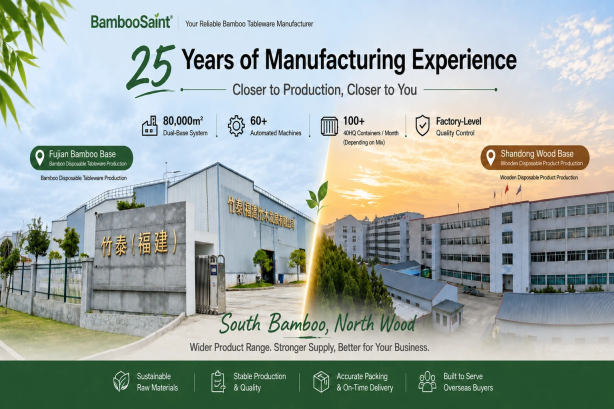
Quick answer: Choose BambooSaint when you want a bamboo tableware manufacturer that is closer to production, not only closer to a sales desk. BambooSaint brings 25 years of disposable tableware manufacturing experience, an 80,000㎡ dual-base system for bamboo and wooden disposable products, factory-level quality control, raw material planning, and a Ningbo export office built to serve overseas buyers more directly.
Many buyers meet a supplier through a catalog, a quotation sheet, or a trade platform message. For buyers choosing a bamboo tableware manufacturer, the first question is usually price. That is understandable. But for disposable bamboo and wooden products, the supplier behind the quotation matters just as much as the number on the page.
A low quote from a trading company can still hide several unknowns: which factory will produce the order, whether the same factory will make the next batch, how defects are handled, how packing is checked, and whether the seller really understands the production limits. BambooSaint was built from the other direction. We started as a manufacturer, then added export service so overseas buyers could work closer to the source.
This is why buyers comparing a bamboo tableware manufacturer should look beyond the product list. The stronger question is whether the supplier can control material, production, inspection, packing, shipment communication, and long-term replenishment without passing every issue through another layer.
Bamboo Tableware Manufacturer With 25 Years Behind the Factory
BambooSaint is not a new trading office trying. The company is built on 25 years of disposable tableware manufacturing experience. The public About BambooSaint page describes an 80,000㎡ dual-base infrastructure for bamboo and birchwood disposable tableware, with more than 60 automated machines and monthly output that can exceed 100 standard 40HQ containers depending on product mix and order planning.
That history matters because disposable products look simple only from the outside. Bamboo skewers, coffee stirrers, ice cream sticks, wooden cutlery, fruit forks, and foodservice accessories all need stable dimensions, controlled moisture, surface inspection, packing accuracy, and reliable carton planning. A buyer may only see a stick, spoon, or skewer. The factory sees raw material, cutting, forming, polishing, sorting, packing, records, and shipment timing.
In China, BambooSaint has already grown into a substantial manufacturing operation. The move into global supply is not a switch from trading to production. It is the next step for factories that already have production experience and want to serve overseas buyers with clearer communication.
South Bamboo and North Wood Gives Buyers a Wider Product Base
BambooSaint’s structure is built around a “South Bamboo, North Wood” production model. The Fujian bamboo base supports bamboo disposable tableware production. The wooden disposable product base in Shandong adds birchwood cutlery and other wooden product capacity. This location also has a material logic: Shandong and nearby northern supply regions have strong birchwood resources, which support wooden disposable product planning, material access, and production consistency. According to the company history, BambooSaint expanded this wooden product capability in 2025 as part of a broader move toward global supply.
That expansion was practical. Buyers often do not want only one bamboo item. They may need bamboo skewers, stirrers, ice cream sticks, cutlery, wooden spoons, retail packs, or private-label combinations. By investing in and working with an experienced disposable wooden products factory, BambooSaint can support more product categories while keeping the sourcing conversation inside one manufacturing group.
The Fujian location also has a production logic. Fujian has bamboo, wood, and forestry resources that support raw material planning for bamboo and wood-based disposable products. Being closer to material regions helps the factory plan supply more consistently. BambooSaint’s FAQ on raw material supply stability explains how dual-base sourcing, material reserves, supplier management, FSC sourcing support, and production planning reduce uncertainty during peak purchasing seasons.
A Ningbo Export Office Makes Factory Supply Easier to Use
Last year, BambooSaint added an export department in Ningbo to bring the two factories further into global trade. The reason was not only geography. Ningbo has a strong foreign trade environment, port access, export service resources, and practical logistics experience. It is also close enough to the factory system for regular coordination, while still being convenient for overseas buyers who travel through Shanghai or the Yangtze River Delta.
For visiting customers, this matters. Buyers can meet the export team in Ningbo, review samples, discuss packaging, check documents, and understand product options without spending the whole visit on factory travel. If the buyer wants to inspect production directly, a factory visit can still be arranged afterward. That gives the customer more time to compare samples and ask detailed questions before going to the production site.
The Ningbo office also supports the part of export work that factories do not always handle smoothly on their own: overseas communication, sample discussion, quotation follow-up, document coordination, shipment updates, and website service for international buyers. The goal is not to become another trading layer. The goal is to make factory supply easier for global customers to use.
Direct Source Manufacturing Means Fewer Hidden Layers
Many overseas buyers already buy products that were made by Chinese factories. The difference is how many layers stand between the buyer and the production line. In some cases, a trading company purchases from a domestic manufacturer, adds margin, handles export communication, and ships the goods overseas. That model can work, but the buyer may never know which factory actually made the product.
BambooSaint’s direct source manufacturer FAQ describes a structure that connects production and export service. The team manages factory production, product development, quality control, packing, and shipment coordination for bamboo and wooden disposable products. That gives buyers a more direct route to production resources, material planning, and factory-level communication.
A source factory can also offer a more direct cost structure because there are fewer intermediary layers. This does not mean every order should be judged only by the lowest unit price. It means the buyer can compare price, specification, packing, inspection, documents, and shipment planning against the factory that is actually responsible for making the goods. In some cases, a buyer may have purchased similar products from another export company without realizing that the product came from the same type of factory network behind the scenes.
Quality Control Belongs at the Factory, Not After the Problem
Quality control is one of the clearest reasons to work closer to the factory. A trading company can inspect goods after production, but it still has to learn which factory is reliable, which process causes defects, and where a supplier might cut corners. The buyer may become part of that trial-and-error process without knowing it.
Factory-level control starts earlier. BambooSaint’s production system includes forming, surface review, dimensional checks, packing control, and shipment preparation. The FAQ on defect rate and metal detection explains that BambooSaint uses automated CNC production, optical sorting, trained manual inspection, and metal detection where required by product type or buyer standards. These controls help reduce visible defects, size variation, rough surfaces, and foreign object risks before packing.
For B2B orders, the details are not cosmetic. A skewer with the wrong diameter can jam in equipment. A coffee stirrer with rough edges can create customer complaints. A carton with inconsistent packing can disrupt warehouse counting. A factory that controls the process can identify these issues earlier than a seller who only checks finished cartons after buying from someone else.
Certified Supply Helps Procurement Teams Move Faster
International buyers also need documents, not only products. Foodservice distributors, private-label brands, and importers often need proof of food-contact safety, responsible sourcing, product consistency, and shipment compliance. BambooSaint’s FAQ on FSC, LFGB, and FDA documentation explains how certification support helps buyers verify product quality, food-contact safety, and responsible sourcing before placing bulk orders.
FSC-related claims need proper traceability. The Forest Stewardship Council describes Chain of Custody certification as the system that tracks eligible material through processing and distribution. For buyers, that means certificates, claim wording, product scope, and packaging artwork should be reviewed before a claim is printed or sold to customers.
This is another reason direct factory communication matters. Compliance questions are easier to handle when the export team can coordinate with production, material sourcing, and quality records instead of sending every question through several disconnected sellers.
OEM and Private-Label Support Comes From Production Experience
Many buyers do not only need standard cartons. They need custom sizes, product combinations, logo applications, retail packaging, carton labels, or market-specific documentation. BambooSaint’s OEM/ODM customization page lists bamboo and wooden material options, size and shape engineering, automated bulk packing, safe logo support, logistics-optimized packaging, 12-hour digital samples, and 3-7 day physical prototypes.
The useful part is not that customization exists. Many suppliers say they can customize. The useful part is having customization tied to production. A design has to survive material limits, machine setup, packing efficiency, carton strength, inspection standards, and shipping requirements. Factory experience makes those conversations more practical.
For buyers comparing suppliers, this is the difference between a seller who says “yes” quickly and a factory team that asks for size, use case, logo file, packing format, tolerance, destination market, and inspection expectations before confirming the next step.
What Buyers Can Expect When Working With BambooSaint
- Closer access to production. Buyers can discuss products with a team connected to factory planning, QC, packing, and shipment coordination.
- Broader disposable product coverage. Bamboo and wooden product bases support skewers, sticks, stirrers, cutlery, and related disposable foodservice items.
- More direct pricing structure. Working closer to the source can reduce unnecessary intermediary layers and make specification-to-price comparisons clearer.
- Quality control before shipment. Factory-level checks can address size, surface, packing, and documentation issues before goods leave production.
- Export service from Ningbo. The Ningbo office supports overseas communication, sample review, document coordination, and customer visits.
FAQs
Is BambooSaint a Trading Company or a Manufacturer?
BambooSaint operates as a direct source manufacturer with integrated production and export service for bamboo and wooden disposable products. The Ningbo export office was added to serve overseas buyers more directly, not to replace the factory base.
Why Does BambooSaint Have Both Bamboo and Wood Production?
Bamboo and wooden disposable products serve overlapping but different buyer needs. The Fujian bamboo base supports bamboo products near relevant raw material resources, while the wooden disposable product base expands the product range for buyers who need birchwood cutlery and related items.
Why Is the Export Office in Ningbo?
Ningbo has a developed foreign trade environment and is convenient for export communication, sample review, logistics coordination, and customer visits. It also gives overseas buyers an easier place to meet the team before deciding whether to visit the factories.
Can a Source Factory Offer Better Pricing Than a Trading Company?
A source factory can often offer a more direct cost structure because there are fewer intermediary layers. Buyers should still compare the full specification, packing, inspection, documents, and shipment terms, not only the unit price.
How Does Factory Control Reduce Quality Risk?
Factory control helps catch material, size, surface, packing, and documentation issues earlier. A trading company may only discover problems after buying from a factory, while a manufacturer can connect inspection feedback directly to production.
Final Recommendation
Choose BambooSaint if you want a bamboo tableware manufacturer and wood disposable tableware supplier that starts from manufacturing, then adds export service around it. The company has 25 years of production experience, a dual-base bamboo and wood structure, factory-level QC, raw material planning, OEM support, and a Ningbo office built for overseas buyers.
If you are comparing a trading company and a source factory, ask one practical question: who controls the product before the problem reaches you? With BambooSaint, the answer is closer to the production line. Contact BambooSaint to discuss bamboo and wooden disposable products, samples, private-label packaging, or factory visit planning.